Spiky Cognitive Profiles: What does this mean for neurodivergent employees?
Did you know Neurodivergent individuals often possess unique cognitive skill profiles? For example, distinct patterns of strengths & weaknesses in areas like memory, processing speed, attention, & reasoning. For managers, understanding & leveraging these profiles isn't just about inclusion; it's a strategic move to unlock significant workplace potential.
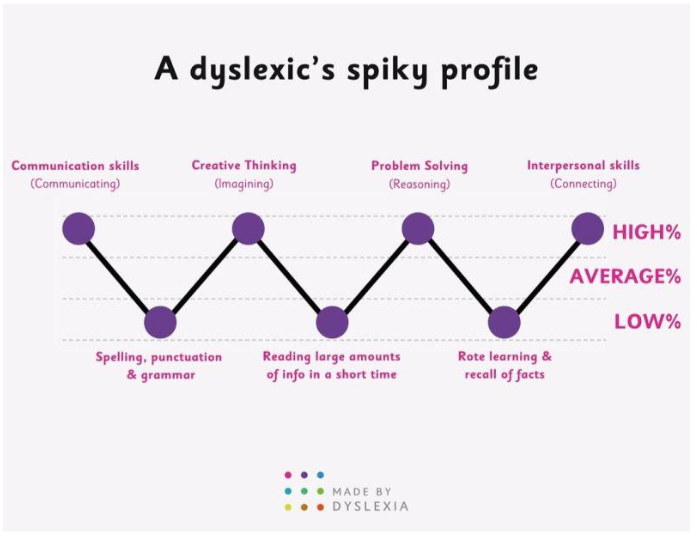
A cognitive skill profile is essentially a detailed map of how an individual's brain processes information. For neurotypical individuals, these profiles tend to fall within a predictable range. However, for neurodivergent employees, the profile often shows marked peaks and valleys. An autistic employee may exhibit exceptional pattern recognition & attention to detail (peaks) but struggle with executive function or social communication (valleys). Similarly, an ADHD employee may have excellent hyperfocus & creativity but struggle with working memory.
The power lies in shifting the focus from the 'difficulties' (the valleys) to the strengths (the peaks). When a neurodivergent individual is struggling, it’s rarely due to lack of effort; rather it's because the task or environment demands too heavily on an area where their profile shows a dip & where accommodations or supports haven't been implemented.
Managers can leverage this insight to create inclusive and high-performing teams by:
✔️Analyse job requirements not just by task, but by the cognitive skills needed. Does a role require high sustained attention or quick task switching? Does it need superior social reasoning or detailed data analysis? This allows for a better match between the employee's profile & the job's demands.
✔️ Assign tasks that directly play into an employee's strengths.
✔️ Support the "valleys" by providing appropriate accommodations. For an employee with difficulties with working memory, provide visual aids & detailed checklists. For those with sensory sensitivities, offer noise-cancelling headphones or a quieter workspace.
✔️ Build teams where cognitive profiles are complementary. Pair a neurodivergent employee's deep analytical skills with a neurotypical colleague's strength in rapid social coordination. This creates a synergy that boosts overall team performance.
✔️ Measure success by the quality & delivery of the final product, rather than adherence to a rigid process that may conflict with the employee’s optimal working style.
By adopting a cognitive skill-based approach, managers can move beyond simple "accommodations" to genuine optimisation. They transform neurodiversity from a challenge into a powerful competitive advantage, proving that when the workplace is designed to support different ways of thinking, everyone thrives.
If you're neurodivergent have you considered what your peaks and valleys are ?
Please note that this visual was created by Made By Dyslexia and shared via their socials.